Bitcoin Casinos UK 2026: Why No UKGC Site Accepts BTC
None of the 52 UKGC-licensed casinos we currently review accept direct Bitcoin deposits, and that’s not an accident. The UK Gambling Commission permits cryptoassets in principle but classifies them as high risk, and the Financial Conduct Authority’s separate marketing rules add a second compliance layer that most operators don’t think is worth the trouble.
This page exists because “bitcoin casino UK” still pulls hundreds of monthly searches, and the results readers actually see are dominated by offshore unlicensed brands. We’d rather explain what’s really going on than send you to one of those.
Why UKGC-Licensed Casinos Don’t Offer Bitcoin
The shorthand “UKGC bans crypto” gets repeated a lot, and it’s wrong. The accurate position is that the Gambling Commission permits cryptoassets in principle but treats them as a high-risk payment method under Licence Condition 12.1.1. In practice that classification, plus the operational complexity of handling a volatile asset on a regulated balance sheet, is why none of our reviewed operators currently offer it.
Specifically, an operator that wants to accept Bitcoin has to do four things before a single deposit clears. First, review their AML risk assessment and notify the Commission of the new payment method. Second, explain how they’ll handle fiat fluctuation between deposit and stake. Third, document how customer funds would be treated in insolvency. Fourth, prove they’ve disclosed the volatility risks to consumers up front. None of that is impossible. It’s just expensive enough that no UKGC operator we’ve spoken to thinks the addressable UK demand justifies the build.
The bigger lever is the April 2025 emerging risks bulletin. The Commission used it to formally classify cryptoassets as a high-risk indicator for source-of-funds checks. In practical terms, that means any customer depositing crypto, or whose wealth came from crypto trading, automatically triggers enhanced due diligence. The reference case the bulletin cites is the February 2025 ByBit hack – $1.5 billion in stolen digital assets, with proceeds suspected of moving through online gambling platforms. After that, no compliance team is in a hurry to open a Bitcoin cashier.
There’s also a more boring reason. The UK casino market is already mature, and the operators we review process billions in fiat volume through debit cards, e-wallets, and Open Banking. Adding a crypto rail with high-touch compliance for what would be a tiny share of deposits is a bad return on engineering time. That’s the commercial answer, and it’s the one most operators give privately when asked. The FCA’s separate rulebook then piles on a second layer of complications, which is the next piece of the puzzle.

Play Responsibly
Gambling should be entertaining — never a way to make money or resolve financial difficulties. Set a budget and time limit before you play, never chase losses, and step away when it stops being fun.
If you feel gambling is affecting your life, free and confidential help is available now:
📞 National Gambling Helpline: 0808 8020 133 (free, 24/7)
- GamCare Free support and counselling for anyone affected by gambling | gamcare.org.uk
- GambleAware Advice and resources to help keep gambling safe | BeGambleAware.org
- Gamblers Anonymous A peer-support fellowship for those seeking recovery | gamblersanonymous.org.uk
- GAMSTOP Free self-exclusion from all UK-licensed online gambling sites | gamstop.co.uk
Read our full responsible gambling guide for tools, UK rules, and support.
The FCA Layer: PS23/6 and Crypto Marketing
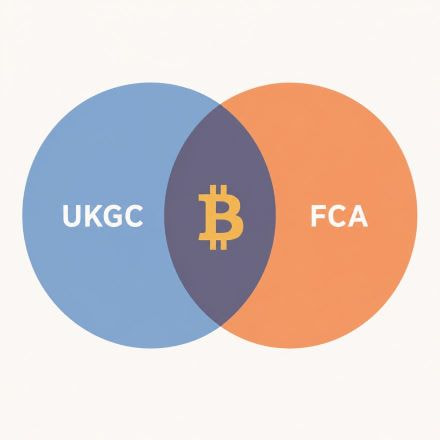
The UKGC rules don’t exist in isolation. Anything an operator publishes that promotes crypto to UK consumers also falls under the Financial Conduct Authority’s financial promotion regime. That’s a separate regulator with its own rulebook – and it explicitly extends to overseas firms targeting UK users.
The relevant rule is Policy Statement PS23/6, in force since 8 October 2023. It applies to any firm marketing cryptoassets to UK consumers, including operators based outside the UK. The headline requirements are:
- Mandatory risk warnings on all crypto promotions, in standardised wording the FCA prescribes
- A 24-hour cooling-off period for first-time investors before they can complete a transaction
- An overarching duty that promotions must be “fair, clear, and not misleading”
- Personalised risk warnings and appropriateness assessments at sign-up
The supporting non-handbook guidance, FG23/3, spells out the FCA’s expectations for firms approving these promotions. The combined effect is that any UKGC-licensed operator that wants to advertise Bitcoin acceptance has to comply with two regulators at once: the Commission for the gambling licence, and the FCA for the marketing of the crypto element. Most operators we’ve spoken to take one look at the overlap and decide it isn’t worth the legal review.
This is also why you’ll notice that the operators on this site – the ones we’ve actually tested – keep their cashiers stocked with PayPal, Skrill, Neteller, debit cards, mobile wallets, and Trustly Open Banking. Those rails sit cleanly inside one regulator’s remit. Bitcoin doesn’t.
What “Bitcoin Casino UK” Search Results Actually Show
If you’ve already searched “bitcoin casino UK” on Google, the brands at the top of the page aren’t UKGC-licensed. We’ve checked. Almost without exception, they hold an offshore licence – typically Curaçao, Anjouan, or Costa Rica – and they market into the UK without any UK regulatory cover.
For a UK player, the difference matters more than people think. UKGC-licensed casinos have to abide by the Licence Conditions and Codes of Practice. They have to participate in GAMSTOP, the national self-exclusion scheme. They have to offer independent dispute resolution through approved bodies like IBAS. They’re subject to UK Advertising Standards Authority enforcement. If something goes wrong, you have routes to recover funds and complaints processes that actually have teeth.
Offshore brands have none of that. GAMSTOP doesn’t apply, which is sometimes the entire reason a player ends up there. There’s no IBAS, no Commission to escalate to, and no UK consumer-protection regime backing your account balance. If the operator decides to void winnings, freeze your account, or just disappear, your options are essentially the small-claims court of whichever jurisdiction issued the licence – not realistic for a UK player.
We’re flagging this directly because it’s the single biggest reason we don’t recommend chasing the “bitcoin casino UK” search-result top ten. The brands are real and the games work. But the consumer protections that make a UK gambling licence valuable simply don’t apply to them. If you came here looking for what UK players use instead, the realistic payment alternatives are further down.
What Bitcoin Actually Is (And Isn’t)

Bitcoin is a decentralised digital currency launched in January 2009 by an anonymous developer (or group) using the name Satoshi Nakamoto. Transactions are verified by a global network of computers, recorded on a public ledger called the blockchain, and don’t require a bank or payment processor to settle. Total supply is hard-capped at 21 million coins.
What Bitcoin is not is a casino payment rail in the regulated UK market. The properties that make it interesting as an asset – pseudonymity, irreversibility, no central issuer – are precisely the properties that make it hard to reconcile with UK gambling AML obligations. A regulated operator needs to know who you are, where your money came from, and be able to refund a deposit if you dispute it. Bitcoin’s design pushes against all three.
That doesn’t make it a bad currency. It makes it a poor fit for a sector where the regulator’s primary tool is verifying the identity behind every transaction. So while you can absolutely buy, hold, and trade Bitcoin in the UK through FCA-registered exchanges like Coinbase, Kraken, or Bitstamp, you can’t currently use it to deposit at a UKGC-licensed casino. Those are two separate regulatory worlds. For the methods that actually work at UK casinos, see the realistic alternatives section next.
Realistic Payment Alternatives for UK Players
If you’ve landed here looking to fund a UK casino account and Bitcoin specifically isn’t the goal, the table below covers the methods that actually work at UKGC-licensed sites. Each row links to that method’s dedicated page on this site, plus a tested operator that processes it cleanly.
| Bitcoin Alternative | Type | Payment Rating | Withdrawals | Available at |
|---|---|---|---|---|
| PayPal | E-Wallet | 4.95/5 | Yes | Fun Casino |
| Trustly | Open Banking | 4.85/5 | Yes | Videoslots |
| Skrill | E-Wallet | 4.70/5 | Yes | NetBet |
| Neteller | E-Wallet | 4.65/5 | Yes | Duelz |
| Apple Pay | Mobile Wallet | 4.85/5 | Yes | Ladbrokes |
For the closest functional match to “I want to use a digital wallet that isn’t a bank card”, PayPal is the cleanest fit. It’s an e-wallet, the integration is mature, almost every UKGC site we review accepts it, and welcome bonuses generally qualify on PayPal deposits. Skrill and Neteller are narrower in acceptance and more often excluded from welcome offers, but they’re the closest equivalents to a “stored-value” model.
If your interest in Bitcoin was about speed and bypassing the bank entirely, the modern answer is Trustly Open Banking. It moves money account-to-account in seconds, settles directly with your bank without exposing card details, and is fully covered by UK PSD2 consumer protections. For most readers who came here looking for “fast, no card, regulated”, Trustly is the answer Bitcoin can’t be inside the UKGC framework.
A note on what’s missing: we haven’t included prepaid vouchers like Paysafecard. Even the best casinos with Neosurf do not allow withdrawals to prepaid cards – a meaningful limitation if you’re treating crypto’s ‘two-way flow’ as the feature you want to replicate. Bank Transfer is also viable but slower than Open Banking, so we haven’t featured it here either.
If part of the reason you were looking at Bitcoin was to skip identity checks, the warning in the next section is the most important thing on this page – read it first.
A Direct Warning on No-KYC and Anonymous Casinos
A non-trivial chunk of the “bitcoin casino UK” search demand is for “no KYC” or “anonymous” variants. We see it in the keyword data. We’re going to be unusually direct about this one because the consequences for UK players are real.
Any platform offering UK consumers real-money gambling without identity verification is, by definition, operating outside UKGC rules. The Commission’s AML guidance and the underlying Money Laundering Regulations require licensed operators to verify customer identity and conduct ongoing source-of-funds monitoring. A site that lets you deposit and withdraw without ID is either offshore-licensed (and not legally targeting the UK) or unlicensed entirely.
The practical risks for a UK player using one of these:
- No GAMSTOP coverage – if you’ve self-excluded, these sites won’t honour it
- No dispute resolution – if the operator voids your winnings or freezes your account, there’s no UK ombudsman
- No deposit-protection assurance – your balance is held at the operator’s discretion
- UK tax implications on crypto winnings are your own problem to track and report
- If the operator is later sanctioned by UKGC for advertising into the UK, your account may be frozen mid-flight
We’re not going to link to any of these sites and we don’t recommend looking for them. If self-exclusion bypass is the reason you’re searching, the most useful thing we can point you to is the National Gambling Helpline on 0808 8020 133 – it’s free, 24/7, and confidential. There’s also a longer guide on what to do if GAMSTOP isn’t holding in our responsible gambling hub.
For more on how the UK gambling and crypto regimes overlap in practice, the FAQ below covers the most common follow-up questions, including the HMRC tax implications of using crypto to gamble.
Frequently Asked Questions From British Players
Below are the questions we hear most often about Bitcoin and UK casinos.
The Bottom Line for UK Players in 2026
There’s a clean version of this answer and a longer version. The clean version: if you want to play at a UKGC-licensed UK casino, you can’t pay with Bitcoin today, and you probably won’t be able to for the foreseeable future. The compliance burden is too heavy and the addressable demand is too small.
The longer version is that the UK gambling and crypto regimes are moving in opposite directions. Gambling regulation is tightening – tighter affordability checks, tighter advertising rules, tighter source-of-funds. Crypto regulation under the FCA is also tightening, but on a different vector (consumer-protection-led rather than AML-led). Where those two converge, the result is more friction, not less. So the realistic forecast is that direct Bitcoin acceptance at UKGC casinos remains a non-starter for the next few years.
If your real interest was speed, no card, no bank middleman, the modern UK answer is Trustly Open Banking. If your interest was a single wallet across multiple sites, that’s PayPal. And if your interest was self-exclusion bypass, the honest answer is to call 0808 8020 133 and not gamble at all today. We’d rather say that out loud than pretend an offshore Bitcoin casino is a UK option.