High Variance vs Low Variance Slots: What the Labels Mean
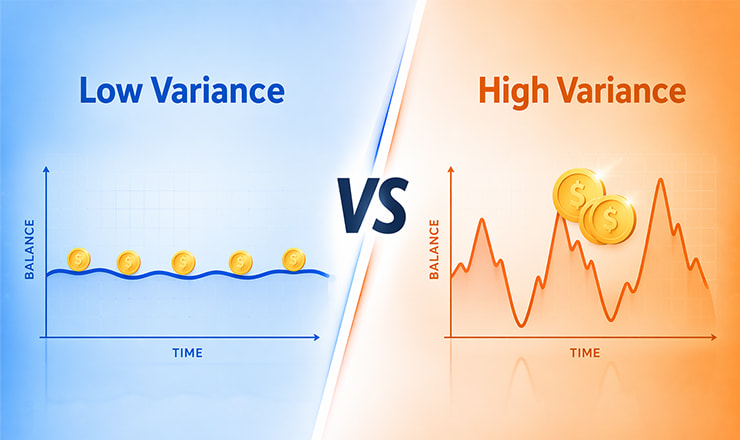
Every online slot has a variance (or volatility) rating that describes how its payouts are distributed. A high-variance slot pays out less often but in larger amounts per win. A low-variance slot pays out more frequently but in smaller amounts. The total amount returned over time, the RTP, can be identical between them. Variance tells you how that return is delivered, not how much.
 Written by:
What Slot Variance Actually Measures
Variance describes the pattern of a slot’s payouts. The question it answers: Does this game pay small amounts often, or larger amounts rarely?
You’ll see both “variance” and “volatility” used across the industry. They mean the same thing, and some providers just prefer one term over the other. Neither has a strict definition in the slots world, which is why ratings appear as broad labels (low, medium, high) rather than exact numbers.
The table below shows how payout behaviour shifts across the three main levels:
| Variance Level | Win Frequency | Typical Win Size | Session Behaviour |
|---|---|---|---|
| Low | Frequent | Smaller per win | Balance stays fairly stable with fewer dry spells |
| Medium | Moderate | Mixed: some small, some larger | More swing between sessions; balance moves up and down noticeably |
| High | Infrequent | Larger per win | Long stretches without returns; most value sits inside bonus rounds |
Variance does not change how much a game returns in total. A low-variance slot and a high-variance slot can both carry a 96% RTP. The low-variance game spreads that 96% across many small payouts. The high-variance game packs it into fewer, larger wins, with longer gaps between them.
How Each Level Feels in Practice
Low Variance
Low-variance slots return small amounts regularly, so your balance tends to stay close to its starting point for longer. Sessions rarely swing hard in either direction, and base-game wins carry a bigger share of the total return. You don’t depend as heavily on triggering bonus features.
These games suit players who prefer longer sessions with steadier results. The trade-off is that each win tends to be smaller, and the payout ceiling is usually lower than in high-variance games.
Example: Starburst (NetEnt), low variance, 96.09% RTP. Both-ways paylines and expanding wilds produce frequent small wins.
Medium Variance
Medium-variance slots sit between the two ends. Balance swings are bigger than with low-variance games, but dry spells are shorter and less harsh than with high-variance titles. The return splits more evenly between base-game wins and bonus features.
That balance is why medium variance appeals to the widest range of players. Most standard video slots fall into this bracket.
Example: Centurion Megaways (Inspired Gaming), medium variance, 95.90% RTP. Base-game reel modifiers keep things active between bonus triggers.
High Variance
High-variance slots pay out the least often, but each win tends to be much larger. Most of the game’s total return sits inside bonus rounds, especially free spins with multiplier mechanics. During base play, you can go through long stretches without anything coming back.
These games suit players who are comfortable waiting through long dry spells for higher returns per winning event. Most Megaways slots fall into this category, as do many modern feature-heavy video slots.
Examples: Dead or Alive (NetEnt), Book of Dead (Play’n GO), and Bonanza Megaways (Big Time Gaming). All three are high variance, with most of their return packed into the free spins round.
For ranked picks in this category, see our high variance slots guide.
Variance vs RTP: They Measure Different Things
Players often mention variance and RTP together, but they answer very different questions:
- RTP (Return to Player) tells you how much a game returns over time. A 96% RTP means the game pays out £96 for every £100 wagered over millions of spins.
- Variance tells you how that return arrives: in many small amounts, or in fewer larger ones.
Two games can share the same RTP but feel completely different. Starburst (96.09% RTP, low variance) and Book of Dead (96.21% RTP, high variance) return a similar total, yet a 100-spin session on each will produce very different balance charts.
For a fuller breakdown of how RTP works, see our guide to Return to Player.
Variance vs Payout Rate
Another common mix-up is “high variance” versus “high payout”. They’re not the same thing. A high-variance slot doesn’t automatically qualify as a high-payout slot; it just delivers its returns in a more concentrated, less frequent pattern.
A game’s payout rate depends on its RTP, not its variance. A low-variance slot with 97% RTP returns more over time than a high-variance slot with 94% RTP. It just does so in smaller, more regular amounts.
How to Check a Slot’s Variance Before Playing
Unlike RTP, providers don’t always show variance in the game’s paytable. Some do: Pragmatic Play rates games on a 1-5 scale, and NetEnt and Blueprint Gaming usually state it directly. Others leave it out entirely.
When you can’t find the rating, you can estimate it from other clues:
- Max win multiplier: games with max wins above 10,000x are almost always high variance. Games capped at 500x-2,000x tend toward low or medium.
- Bonus round structure: if the biggest payouts depend on free spins with escalating multipliers, that usually signals high variance. If base-game wins drive most of the return, it’s likely lower.
- Game reviews and data sites: independent review sites and provider data sheets usually list variance ratings even when the in-game paytable doesn’t.
Independent reviews and provider data sheets are the most reliable way to confirm a rating before you commit real money.
Which Variance Level Suits You?
| If You Prefer… | Consider | Why |
|---|---|---|
| Longer sessions with steadier results | Low variance | Smaller balance swings, more frequent returns |
| A balance between frequency and win size | Medium variance | Moderate risk, mixed payout sizes |
| Fewer but larger payouts | High variance | Higher per-win returns, focused on bonus rounds |
| The Megaways format specifically | Check individual titles | Most are high variance, but a few (Eye of Horus Megaways, Centurion Megaways) are lower |
There’s no single “best” variance level. It depends on how you prefer a game to behave. What matters is that your choice is informed rather than accidental. Checking variance before you play takes less than a minute, and it tells you more about how a session will feel than almost any other single metric.
Frequently Asked Questions
Volatility shapes how a slot feels to play, and it’s easy to lose track of what the term actually means. Here are the questions UK players ask most about it.