Roulette Betting Strategy Guide – Tips, Tactics, Betting Systems, Do’s & Don’ts
Let us start with the point many roulette guides leave until the end: no betting system can change the house edge. Not even Martingale, Fibonacci, or Labouchere. For standard regulated online roulette and properly maintained live tables, each spin is independent and previous stakes do not affect the house edge. This roulette betting strategy guide explains how payouts work and examines the most popular betting systems used in this iconic casino game.
 Written by:
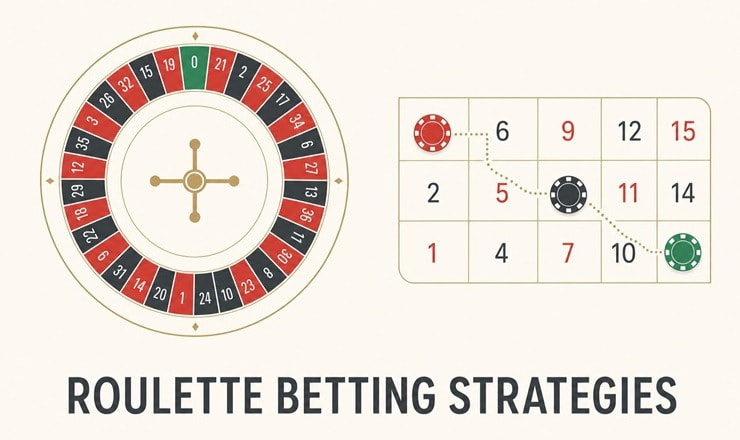
How Roulette Odds Actually Work
A roulette wheel pays out as though the zero were not there. On a European wheel there are 37 pockets, numbers 1 to 36 plus a single zero, but a winning straight-up number pays 35 to 1 rather than the 36 to 1 that would make the bet even. That gap is the house edge, and on a single-zero wheel it works out at 2.70%.
An American wheel adds a second zero. Now there are 38 pockets, the payout is still 35 to 1, and the edge more than doubles to 5.26%. Same game, same bets, a slightly different table layout, roughly twice the long-run cost. Choosing the single-zero table is the one decision that measurably changes what roulette costs you.
The third variant, French roulette, goes further still. It uses a single-zero wheel and adds a rule called La Partage, where a zero returns half your stake on even-money bets instead of taking all of it. A related rule, En Prison, typically holds an eligible even-money bet for one further spin after zero. Where either applies, the edge on those even-money bets falls to roughly 1.35%.
| Wheel | Pockets | House Edge |
|---|---|---|
| French (with La Partage) | 37 (Single Zero) | About 1.35% on even-money bets |
| European | 37 (Single Zero) | 2.70% |
| American | 38 (Double Zero) | 5.26% |
La Partage isn’t on every table, though, and where it applies it generally covers even-money bets only.
Rather than assuming a system such as Martingale will work, compare the rules and house edge first. Start by checking what leading roulette sites offer, then choose a table variant and bet types you understand. Experimenting with real money is rarely a good idea.
Inside vs Outside Bets & Payouts
Roulette bets split into two categories. Inside bets cover single numbers or small groups of them, so they pay more and land less often.
The second category is outside bets, which cover larger sections of the layout like red or black, odd or even, and dozens. Their payouts are lower, but they hit more frequently. The table below outlines the payout rates for both categories.
| Bet | Covers | Pays |
|---|---|---|
| Straight up (Inside) | 1 Number | 35 to 1 |
| Split (Inside) | 2 Numbers | 17 to 1 |
| Street (Inside) | 3 Numbers | 11 to 1 |
| Corner (Inside) | 4 Numbers | 8 to 1 |
| Six Line (Inside) | 6 Numbers | 5 to 1 |
| Dozen/Column (Outside) | 12 Numbers | 2 to 1 |
| Red/Black, Odd/Even, High/Low (Outside) | 18 Numbers | 1 to 1 |
Now the part that surprises people: on a given wheel, every one of those bets carries the same house edge. A straight-up number and a red/black bet cost you the same percentage over time. What changes is the playing style. Neither is smarter. They just suit different temperaments and bankrolls.
Yet, these are only the most common types of inside and outside bets. Some tables allow you to use a special feature, called the ‘racetrack’ or ‘carousel’. With it, you can place several chips across wheel sections in one click. Voisins du Zero covers 17 numbers, Tiers du Cylindre covers 12, and Orphelins covers eight. Jeu Zero focuses on numbers near zero.
Roulette Betting Strategies, Honestly
Every popular roulette betting strategy is a rule for changing your stake after a win or a loss. None of them touches the odds of the next spin, because the wheel does not know what happened on the last one. What they change is how your bankroll behaves along the way, and each has a specific failure mode:
| System | The Rule | Where It Breaks Down |
|---|---|---|
| Martingale | Double your stake after every loss. | Stakes escalate brutally fast. A run of losses hits the table maximum or empties the bankroll, and one capped bet wipes out every small win before it. |
| Reverse Martingale (Paroli) | Double after every win, reset after a loss. | Streaks end. The loss always lands on your largest stake, handing back the run in a single spin. |
| D’Alembert | Up one unit after a loss, down one after a win. | Gentler than Martingale, but it assumes wins and losses roughly balance out. Over a long enough session the zero makes sure they do not. |
| Fibonacci | Move along the sequence after a loss, back two after a win. | Slower escalation, same ending. A long losing run still pushes stakes past what most bankrolls or table limits allow. |
| Labouchere | Cross numbers off a target sequence as you win. | Losses lengthen the sequence, so stakes grow while the target recedes. Hardest of the five to track once a session goes badly. |
We walk through each of those, plus the James Bond system, in our full guide to roulette betting systems, with a worked example in pounds for each. Progressive betting strategies for roulette trade lots of small wins for the occasional very large loss, which is why they feel like they are working right up until they are not. The same mathematical principle is explained in the guide to slots strategy. No staking pattern turns a negative-edge game into a positive one, and roulette has been negative-edge since the zero was added to the wheel.
Do Any Roulette Strategies Work
It depends what you want a roulette betting strategy to do. If you expect to turn roulette into a long-term winner, no, and anyone selling that is selling a myth. The belief that a colour is ‘due’ after a run is the gambler’s fallacy, a well-documented error. Indeed, a long run of black should tell you nothing about the next spin.
The wheel has no memory of where the ball last landed, and nothing in it balances the books later. Each spin starts from the same 37 or 38 pockets. So, if you seek fun and a more enjoyable gaming session by using betting strategies for roulette, then yes, they can work. Here are a few things that can genuinely help:
- Pick the Single-Zero Wheel – the only choice that changes the actual edge, and French rules better still.
- Set a Budget Before You Start – decide the amount you are content to lose, and treat it as the cost of the entertainment.
- Size Stakes for the Session Length You Want – smaller units on outside bets stretch a bankroll further than chasing straight-up numbers.
- Decide Your Walk-Away Point in Advance – both the losing limit and the winning one. Also, besides using the best betting strategy in roulette, you should also know when to cash out your winnings.
- Don’t Be Distracted by Other Players – their streaks, superstitions, and betting patterns do not affect your odds, so stick to your own budget and plan.
These are the same honest bits of advice we share for card tables in the blackjack strategy guide. There is one real difference: in blackjack your decisions affect the edge, so basic strategy measurably reduces it. In roulette they do not. Once the bet is down, the wheel does the rest. That is also why live dealer tables play exactly the same as the RNG versions in odds terms.
Playing Responsibly
Roulette is designed as entertainment with a known cost. That cost only stays acceptable if you fix the amount in advance, which is what deposit and session limits are for. Every UK-licensed site runs its games on tested random number generators and has to meet the UKGC’s fairness standards.
However, ‘fair’ means the stated odds are the real odds. It does not mean the edge goes away. If a session stops being fun, or you find yourself staking more to recover what you have lost, that is the moment to stop rather than adjust the system.
Deposit limits, time-outs and self-exclusion are built into every licensed site, and the full guide to minimising online casino losses covers all practical tools in more detail. For further help, GambleAware offers free, confidential support, and the National Gambling Helpline is available on 0808 8020 133.
Frequently Asked Questions
Below, we answer common questions about roulette betting strategies, game rules, odds, and wheel variants. Remember that roulette outcomes are random, and no strategy can remove the house edge or guarantee a profit.
Sources & Further Reading
- Roulette – wheel layouts, house edge and La Partage – Wikipedia
- UK Gambling Commission – licensing and game fairness requirements – gamblingcommission.gov.uk
- Gambler’s Fallacy – Hahn, U. (2011), Oxford Bibliographies Online – Birkbeck, University of London
- GambleAware – free, confidential advice and support
- Online Roulette – the variants UK sites offer – BestCasino.co.uk
- Blackjack Strategy Guide – where decisions do change the edge – BestCasino.co.uk
- Online Slots Strategy – the same honest framing for slots – BestCasino.co.uk