Tax on Gambling Winnings in the UK
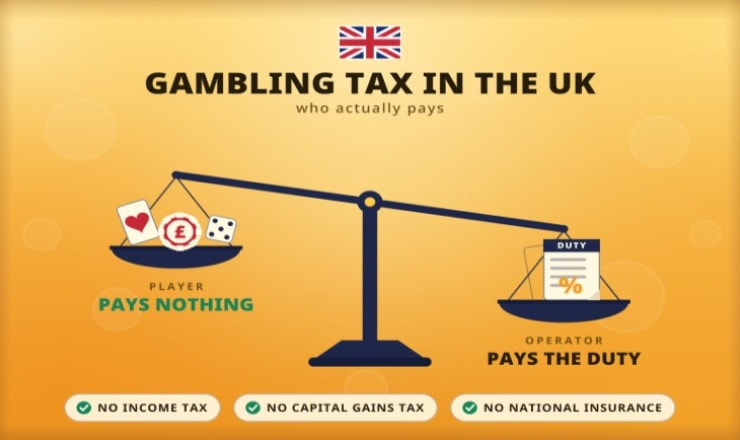
The gambling tax in the UK is charged to the gaming operators, not the player, and HMRC’s position is that betting is not a trade. This blog post explains where the rule comes from, when the Government takes an interest, and which fringe cases may apply.
 Written by:
Do You Pay Winnings Tax, Indeed
If you play in the UK, your gambling winnings are not taxed, regardless of the game or amount won. The UK Gambling Commission puts it in plain terms: ‘in the UK, winnings from gambling for customers are tax-free, regardless of the amount won.’
This post explains the general rules only and does not constitute personal tax advice. It is not personal tax advice. For your own circumstances, you should consider the guidance on GOV.UK or speak to a qualified tax adviser.
Neither income tax nor capital gains tax applies. Of course, there are some exceptions and they are narrow. These exceptions generally concern payment for services or income from a trade, rather than gambling winnings themselves.
National Insurance does not apply either, and that is arithmetic rather than a special exemption: it is charged on earnings from employment and self-employment, and a win is neither. This position holds across every gambling product a British player is likely to use, including:
| What You Won It On | Taxed? | Why |
|---|---|---|
| Online Casinos and Slots | No | Duty falls on the gaming provider. |
| Bingo | No | Not trading income for the player. |
| Sports Betting | No | The bookmaker carries the betting duty. |
| Poker, Cash Games and Tournaments | No | Still a bet, however much skill is involved. |
| Live Dealer and Land-Based Tables | No | The casino pays duty on its own profits. |
So, Who Actually Pays Gambling Tax
UK gambling duties are generally charged to gambling businesses rather than individual customers. On 6 October 2001 the charge was based on total stakes minus winnings paid to customers, so it applied to the bookmaker’s profit margin. Then on 1 December 2014 the remote duties moved onto a place-of-consumption basis.
‘RGD is charged on the gaming provider’s profits from remote gaming played by a UK person regardless of where in the world the provider is located.’
Hence, licensing has become a very important part of the legal side. The full guide to what the UK Gambling Commission does should be high on your agenda if you want to find out more. Here are the duties paid by the businesses and their rates for the 2026 to 2027 tax year.
- Remote Gaming Duty: 40% of an online gaming provider’s profits from remote gaming, up from 21% on 1 April 2026.
- General Betting Duty: 15% on fixed-odds bets and totalisator bets on horse and dog races, paid by the bookmaker.
- General Betting Duty on Spread Bets: 3% on financial spread bets and 10% on other spread bets, again paid by the firm.
- Pool Betting Duty: 15% of the promoter’s net pool betting receipts.
- Gaming Duty: banded at 15%, 20%, 30%, 40% and then 50% on the remainder, paid by land-based casinos.
- Machine Games Duty: 5%, 20% or 25% depending on the machine, paid by the machine operator.
- Bingo Duty: abolished from 1 April 2026, with nothing to register for or return after that date.
One further change has been announced. A remote rate of General Betting Duty at 25% will apply to remote bets other than remote bets on UK horseracing, and it does not take effect until 1 April 2027. These duties are generally paid by the operator and are not separately charged to a player’s withdrawal. The duty is settled by the operator on its own profits before any withdrawal is paid out, so there is nothing for you to declare.
When HMRC Does Tax Gambling Money
Being lucky in gambling does not create a tax bill, and nor does doing it full time. The HMRC’s Business Income Manual states that betting and gambling, as such, do not constitute trading. The manual goes further on the professional gambler question by explaining that having a betting system or earning a living from gambling does not by itself make the activity a trade.
Behind that sits Graham v Green [1925] 9 TC 309, where Rowlatt J described a bet as ‘merely an irrational agreement that one person should pay another person on the happening of an event.’ HMRC still quotes the shortest line from the case: ‘There is no tax on a habit’. The trade belongs to the other side, in other words – an organised activity to make profits out of the gambling public will normally amount to trading.
A casino winnings tax may apply where a person is paid for providing services. So, some people described as professional gamblers do carry on a trade when they are paid for services, and television appearance fees is an example. However, a darts or snooker player competing for prize money is in a different position.
Where someone competes in a business-like, profit-seeking way, their professional earnings are trading income, and the ‘Amateur’ label is not decisive. Similarly, sponsorship, endorsements and media work are generally taxable income.
Exceptions & Edge Cases
Spread Betting. For a private individual, a spread bet is treated like any other bet and is not normally taxable, subject to the same trading test as gambling generally. It may be treated differently where the activity amounts to a trade. The firm pays duty of its own, 3% on financial spread bets and 10% on the rest.
Crypto Casino Winnings. HMRC treats using cryptoassets to take part in betting or gaming the same way as cash, with excise duty due from the bookmaker or gaming provider, so the win follows the normal position. What you do with any cryptoassets received after gambling at a Bitcoin online casino, for example, is a separate capital gains question, since selling, swapping or spending tokens each counts as a disposal.
Game Show and Competition Prizes. A one-off prize is not usually taxable in the hands of the winner. The exception is the same trading test again: where entering competitions is part of how someone carries on a trade or profession, the payments can belong to that trade. Lottery and pools prizes are a separate subject.
Winnings Abroad. Another country’s rules apply to money won there. For instance, a US payer generally withholds 30% on gambling winnings paid to a foreign person, though blackjack, baccarat, craps and roulette are excluded from that regime for non-professional non-resident aliens. A double taxation treaty can change the outcome, and Article 22 of the UK/USA convention provides that income not dealt with elsewhere in it ‘shall be taxable only in’ the state where the recipient is resident. Casino winnings tax may still be withheld at the time and reclaimed afterwards through a US non-resident return.
Non-Residents Winning in the UK. UK duty is charged to the operator on its profits, not to the customer, and HMRC’s published position that betting and gambling do not constitute trading is not written by reference to where the player lives. A visitor’s own country may still have a betting winnings tax, and that is where they need to check.
Why a Casino Still Asks Where Your Money Came From
A source-of-funds request is not HMRC knocking, as it comes from the casino’s own licence conditions. Condition 12.1.1 of the UK Gambling Commission’s Licence Conditions and Codes of Practice requires licensees to assess their money-laundering and terrorist-financing risk and to keep written policies and controls, reviewed at least annually.
The UKGC’s 2026 assessment of money laundering and terrorist financing risks in the British gambling industry treats a failure to scrutinise source-of-funds documents as an operator control weakness, and one worked example concerns a customer who is asked to provide source-of-funds information as part of know your customer checks (KYC). The full guide to casino verification and withdrawals will run you through the different types of documents, which is a different requirement from affordability checks.
Keeping a record of a large win is still sensible. There is no entry for a gambling win on a tax return, because it is not taxable income, so a screenshot, a bank statement or the withdrawal confirmation exists to explain where money came from to a bank or an operator, not to support a filing. Deciding when to withdraw rather than play on is a separate question, and not a tax one.
Frequently Asked Questions
This section answers some of the questions players ask most often about tax on gambling winnings in the UK. So, consider reviewing them and reading this blog post carefully.
Sources & Further Reading
- Winnings from gambling for customers – Gambling Commission
- BIM22015: betting and gambling, introduction – HMRC Business Income Manual
- BIM22017: betting and gambling, the professional gambler – HMRC Business Income Manual
- BIM22020: betting and gambling, spread betting – HMRC Business Income Manual
- Excise Duty: Gambling Duty rates – HM Revenue and Customs
- Remote Gaming Duty (Excise Notice 455a) – HM Revenue and Customs
- Gambling duty changes – HM Treasury and HM Revenue and Customs (26 November 2025)
- Capital Gains Tax: what you pay it on – GOV.UK
- CRYPTO47000: betting and gaming – HMRC Cryptoassets Manual
- What Is the UKGC and What Does It Do? – BestCasino.co.uk
- Casino Verification & Withdrawals: A UK Player’s Guide – BestCasino.co.uk