UK Casinos No Longer Accept Credit Cards
British online casinos stopped taking credit cards on 14 April 2020, and this guide covers the credit card gambling ban, why the UK Gambling Commission brought it in, and how far it reaches. The e-Wallet part is where most confusion sits, so we have also given it proper space, along with what the 2021 evaluation found and which payment methods you can still use.
 Written by:
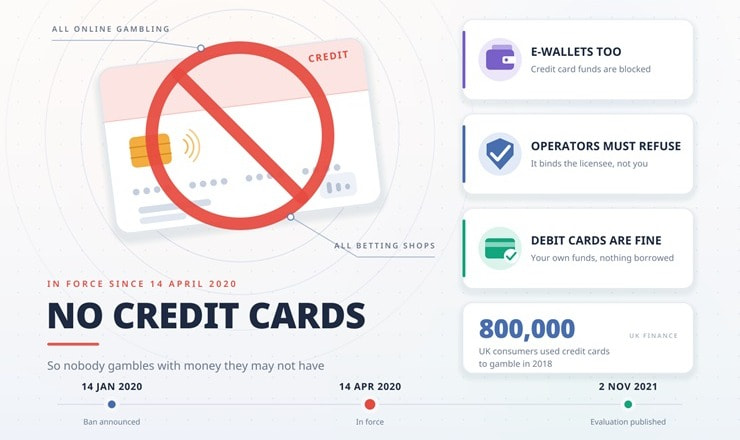
What the Credit Card Ban Covers
The rule is short, and the wording leaves very little room for interpretation: ‘Licensees must not accept payment for gambling by credit card. This includes payments to the licensee made by credit card through a money service business.’ That wording is from licence condition 6.1.2 of the Licence Conditions and Codes of Practice – the rulebook every licensed operator signs up to.
The UK Gambling Commission announced the change in January 2020 and gave the industry three months to get ready for it. The condition reaches all online and offline gambling products, with the single exception of non-remote lotteries like shop-bought lottery tickets and scratchcards.
In licensing terms it binds all non-remote general betting, pool betting and betting intermediary licences, plus all remote licences, including ancillary remote betting and ancillary remote lottery licences. A credit card still works in two specific situations.
It works for lottery tickets and scratchcards bought in a shop alongside non-gambling products, and it works where the payment is sent by post, with the card details posted to the gambling business. Other than that, no British gambling business has been allowed to take a payment for gambling by credit card. Here is an overview:
| Payment or Product | Credit Card Status |
|---|---|
| Online casino, slots and bingo deposits. | Banned since 14 April 2020. |
| Sports betting, online and in shops. | Credit card payments are banned. |
| Deposits made through an e-Wallet loaded by credit card. | Banned, and operators must reject them. |
| Non-remote lotteries. | Outside the scope of the ban. |
| Lottery tickets or scratchcards bought in a shop with non-gambling products. | They are allowed. |
| Payment sent by post to a gambling business. | They are allowed. |
Condition 6.1.2 binds the licensee, not the customer. You are not breaking any law by trying to pay with a credit card at a British casino, because the business is the party barred from accepting it. Either way the deposit does not go through, so the practical result at the cashier is the same.
Why the UKGC Introduced the Ban
800,000 Britons used credit cards to gamble in 2018, according to UK Finance. Alongside that sat UKGC research published in March 2019, which found that 22% of online gamblers using credit cards to gamble were classed as problem gamblers. That’s why UK online casinos don’t accept credit cards any more, considering that non-remote lotteries are the only exception.
That figure rests on a small sub-sample, roughly 150 credit card users inside a survey of about 2,000 adults, so it works better as an indicator than as a precise measurement. The UKGC credit card ban also followed the Government’s Review of Gaming Machines and Social Responsibility Measures, with a public consultation running from August to November 2019.
Neil McArthur, then chief executive of the Gambling Commission, framed it this way when the ban was announced: ‘Credit card gambling can lead to significant financial harm. The ban that we have announced today should minimise the risks of harm to consumers from gambling with money they do not have.’
Helen Whately (then Culture Minister) made the same argument from the government side: ‘There is clear evidence of harm from consumers betting with money they do not have, so it is absolutely right that we act decisively to protect them.’
However, card payments are only one way by which money reaches a gambling account. How operators judge what a customer can reasonably afford to lose is a separate matter, addressed through regular affordability checks.
That’s why in its player-facing guidance, the UKGC puts the principle more plainly. It says it is clear with gambling businesses that they must reduce the risk of harm from gambling, and that an important part of this is not allowing people to gamble with money that they may not have. Hence the credit card ban in gambling.
How the Ban Reaches e-Wallets
Payments made by credit card through a money service business are caught by the second sentence of the condition, and that phrase covers e-Wallets, fintechs and electronic money institutions. Loading a wallet with a credit card and then pushing the balance into a casino account is exactly the loop the rule closes.
The UKGC put the policing burden on operators rather than on the wallet providers. That left wallet providers with a choice – either build a mechanism that stops credit-card-derived funds from reaching a gambling site, or leave the gambling market.
The regulator acknowledged that some would need separate pots of stored value inside a single wallet, splitting gambling from non-gambling funds, or credit card money from everything else, so that a credit card could still be used for non-gambling purchases through the same account.
PayPal, Skrill, Neteller and Revolut all gave assurances to gambling companies that customers cannot transfer funds to a gambling operator where those funds came from a credit card. That is why those e-Wallets are still on British cashier lists.
Shortly after the credit card gambling ban came in, a small number of transactions did reach player accounts through an e-Wallet where a credit card had been used with that e-Wallet. The regulator has since said it is satisfied that digital wallets loaded with credit cards cannot be used for gambling.
What You Can Use Instead
Debit cards became the leading alternative, and the ban is the reason the cashier list at an online casino looks the way it does. A debit card pulls from money already in your bank account, which is precisely the distinction the condition was written around.
Examples include cards like Visa Debit and Mastercard Debit, both of which are accepted almost everywhere. They are almost as popular as e-Wallets, but offer higher deposit limits and are the deposit method of choice for many high roller players. Here are your top alternatives to credit cards:
- Debit Cards (such as Revolut and Maestro)
- e-Wallets (funded from a debit card or a bank balance)
- Bank Transfer (from a current account)
- Prepaid Vouchers (bought with your own funds)
E-Wallets are still perfectly usable and, in most cases, they are the top alternative. What changed is where the money inside them comes from, so a PayPal, Skrill or Neteller balance funded by a debit card or a bank transfer behaves normally at a licensed casino. Fund the same wallet with a credit card and the gambling payment will be refused.
What the 2021 Evaluation Found
An interim evaluation landed on 2 November 2021, with the full evaluation carried out by NatCen Social Research. The question it set out to answer was whether the ban stopped people gambling with borrowed money, or simply changed which kind of borrowing they used.
The headline finding was that 76% of previous credit card gamblers do not gamble with other types of borrowed money. Against that, 15% reported that the ban resulted in them gambling with other types of borrowed money, which is the displacement effect the consultation had worried about.
Andrew Rhodes, then interim chief executive of the UKGC, viewed it as a success in implementation as well as outcomes. He said: ‘The successful implementation of the ban across the industry… is an encouraging sign that the ban has reduced consumer reliance on gambling with borrowed money.’ After all, this is the main reason why UK casinos don’t accept credit cards as of 2020.
Bank data showed no spike in money transfers or ATM withdrawals after the ban took effect. In the evaluation’s own summary, far more people who previously gambled with a credit card now gamble with available funds than with other types of borrowed money. The condition remains in force, and nothing published by the UKGC points to a planned change.
Frequently Asked Questions
These are the questions UK players ask most often about the credit card gambling ban and what it means at the cashier of an online casino. Read them before making your next deposit at an online casino.
Sources & Further Reading
- Gambling on credit cards to be banned from April 2020 – Gambling Commission (14 January 2020)
- LCCP condition 6.1.2, Use of credit cards – Gambling Commission
- Gambling using a credit card – Gambling Commission
- Changes to licence conditions and codes of practice on the use of credit cards for gambling: E-wallets – Gambling Commission
- Prohibition of gambling on credit cards – Gambling Commission and NatCen Social Research
- Interim evaluation of the credit card ban – Gambling Commission (2 November 2021)
- What Is the UKGC and What Does It Do? – BestCasino.co.uk
- Gambling Affordability Checks: A UK Player’s Guide – BestCasino.co.uk