Blackjack Terms and Table Etiquette: A UK Glossary
From ‘Soft 17’ and ‘Push’ to ‘Insurance’ and ‘Bet Behind’ – this glossary explains all blackjack terms you will find at a UK online casino. It also covers blackjack hand signals and table etiquette for land-based, live and online games. Read it, keep it handy, and try your favourite game of 21 when you are ready.
 Written by:
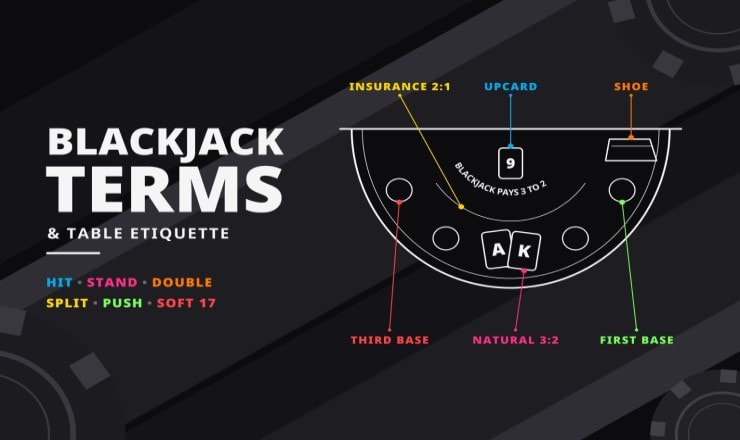
Table Basics: Cards, Shoe and Seats
Many blackjack terms describe the kit on the table before a single card is dealt. Once you know them, a rules panel or dealer call makes sense straight away, in a land-based casino or online. Here is what you need to remember:
- Shoe: the box that holds several decks and feeds cards to the dealer one at a time.
- Cut card: a plastic card in the shoe that signals the next reshuffle when it comes out.
- Burn card: a card the dealer discards unseen, usually right after a shuffle.
- Discard tray: the holder for played cards until the next shuffle.
- Upcard: the dealer card dealt face up, which everyone can see.
- Hole card: the dealer’s face-down card.
- First base and third base: first base, on the dealer’s left, acts first, while third base acts last.
- Table minimum and maximum: the smallest and largest stake per hand, shown on a sign or in the game panel.
At a table in a real UK casino venue, the dealer may not take a second card straight away. The Hippodrome Casino in London’s Leicester Square explains that the dealer is dealt ‘one face up’ and draws another card once all players have taken their turn.
Online and live games often work differently. Some live dealer tables let you take insurance before the dealer checks their other card, which points to a hole card and a check for blackjack.
Blackjack Terms for Hands: Naturals to Soft 17
The table below covers the terms in blackjack you will hear most, centred around the different types of hands. These terms appear in rules panels and dealer calls. You will meet them at every table.
| Term | Meaning |
|---|---|
| Blackjack (Natural) | An ace plus a 10-value card as your first two cards. It commonly pays 3:2, although some tables pay 6:5 or use another stated payout. |
| Hard Hand | A hand with no ace, or one where the ace can only count as 1. |
| Soft Hand | A hand where an ace can count as 11 or 1 without going bust. Ace plus six is a soft 17. |
| Soft 17 | ‘Dealer stands on soft 17’ means the dealer stops on that hand. ‘Dealer hits soft 17’ means the dealer draws again. |
| Bust | A total over 21. The hand loses straight away. |
| Push (Stand-Off) | You and the dealer tie, so your stake comes back to you. |
| Charlie | A rule where a hand reaching a set number of cards without busting wins automatically, such as the Six Card Charlie on Evolution’s Infinite Blackjack. |
The soft 17 line is the one to look for on a rules panel. Some games have the dealer stand on soft 17, while others make the dealer hit soft 17 instead. Some casinos also note that, if you split aces and then draw a 10-value or picture card, the total counts as 21 rather than blackjack, so it does not get the blackjack payout.
What Does Push Mean in Blackjack?
A push means you and the dealer finish on the same total, so nobody wins and your stake is returned to you. It is a tie, which is why some tables call it a stand-off. If you stand on 19 and the dealer also ends on 19, your original bet comes back and you can play the next hand.
A push is not a loss, but nothing is added to your balance either. It can happen with a natural too. If you and the dealer both hold an ace plus a 10-value card, the hand is normally a push, whereas a dealer blackjack beats any other 21 you make. Insurance and side bets settle separately from the main stake, so a push on the main hand does not cancel them. If you are unsure how a tie is settled, the game’s rules panel is the authority.
Player Moves: Hit, Stand, Split and More
Blackjack terminology in the UK has its own accent. Some real dealers may talk about sticking and twisting, while others might ask whether you want to ‘draw’ or ‘stay’. Here are the subtle differences in their definitions:
- Hit (twist): take another card, which UK players often call twisting.
- Stand (stick): keep your total and take no more cards.
- Double down: double your stake, take exactly one more card, then stand.
- Split: turn a pair into two hands by placing a second stake equal to the first.
- Surrender: where offered, ends your hand and typically returns half of your original stake. Usually, late surrender comes after the dealer checks for blackjack and early surrender comes before it.
- Insurance: place a side bet of up to half your stake when the dealer shows an ace. It pays 2:1 if the dealer has blackjack.
- Even money: take a 1:1 payout on your blackjack when the dealer shows an ace, which can be seen as the same thing as insurance.
If a casino policy limits doubling to certain totals, the soft hand definition tells you whether an ace-led hand counts. The full blackjack strategy guide covers when each move makes sense against different dealer upcards.
Bets, Payouts and the House Edge
The blackjack payout is the first number to check at any table. At 3:2, a £10 blackjack pays £15, while a 6:5 table pays £12 for the same hand. That gap adds up about 1.4 percentage points to the house edge, which the guide to how RTP works puts in context.
In short, the house edge is the casino’s long-run margin on a game. RTP is the same figure from your side (100% minus the edge), and neither predicts a single session. The insurance bet follows its own rate. For example, if a casino pays insurance at 2:1, a winning £5 insurance bet returns £10 in winnings plus the £5 stake. Side bets settle separately from the main stake.
Perfect Pairs pays if your first two cards are a pair, and the Hippodrome Casino in Leicester Square runs a version called Pairs on its tables, with mixed, coloured and suited pairs. 21+3 treats your first two cards and the dealer upcard as a three-card poker hand. The qualifying hands can include a flush, straight, straight flush or three of a kind, depending on the game’s paytable. Bet behind lets you stake on another player’s hand without taking a seat of your own.
Blackjack Hand Signals at a Casino Table
At many land-based blackjack tables, dealers rely on standard hand signals as well as the table’s stated procedures. Procedures vary by venue, and some tables may not accept a spoken hit or stand on its own. If in doubt, ask the dealer which signals the table uses. These are the blackjack hand signals commonly used.
| Move | Commonly Used Signal |
|---|---|
| Hit | Scratch the table with your index finger. |
| Stand | Wave your hand over your cards. |
| Double Down | Put out extra chips, no more than your original bet, and show one finger. |
| Split | Place a stake that exactly matches your original bet and make a V sign with two fingers. |
| Surrender | Where it is offered, ask the dealer how the casino wants you to signal it. |
| Insurance | Place up to half your original stake on the insurance line. |
Signals help avoid misunderstandings and, at some venues, support surveillance review if there is a dispute. At online live and RNG tables, the same moves are made using on-screen buttons, so no hand signals are needed.
Table Etiquette in Land Venues
Good blackjack etiquette starts before you sit down. For instance, you should buy chips between hands only, so if a round is under way, wait for it to finish and then ask the dealer for chips. Once the cards are out, leave your stake alone. It is standard table practice, since moving chips mid-hand can look like an attempt to change a bet.
Phone rules differ between casinos, so check the house rules before you take a call at the table. Other players make their own decisions. Blaming someone for ‘taking the dealer’s card’ makes little sense, because every card in the shoe is unknown to you until it is dealt.
If you decide to tip, some casinos’ policies may suggest placing chips on the table and making sure the dealer knows they are for them. Whether tips may be handed directly to a dealer depends on the venue’s policy. Placing a bet on the dealer’s behalf is another way to tip at some tables, but policies vary, so check the casino’s house rules first. In short, each casino sets its own house rules on tips.
Etiquette at Online Casino Tables
Live online blackjack swaps hand signals for buttons, but the chat box is shared with everyone at the table. Keep messages polite and leave out personal details. The dealer runs the game and is not there to advise you.
Make your own call within the betting timer. For more detail, see the full guide to how live dealer games work. It explains how the table reads your decisions. With bet behind the seated player makes the playing decisions. Whether you can follow a split or double depends on the game’s rules.
If you use bet behind at an Evolution table with seven main seats, choose an occupied seat that is actively playing. Sitting in one without playing holds up others, so give up a seat you are not using. Infinite formats remove the queue, with unlimited seats and one shared starting hand. For a comparison of the recommended licensed operators, see the guide to live casino sites for UK players.
What to Check at RNG Blackjack Tables
An RNG blackjack table has no dealer and no other players, so social etiquette drops away. What replaces it is reading the rules panel first. UK rules put this information in front of you, so check the following factors first:
- Payout: whether blackjack pays 3:2 or 6:5.
- Soft 17: whether the dealer stands or hits on it.
- Surrender: whether it is offered, and which kind.
- Decks: how many the game uses.
- RTP: the figure stated for the game.
The UK Gambling Commission’s RTS 3 says an explanation of the rules ‘must be easily available to the customer before they commit to gamble’. It requires information on how the game works, the house edge and the RTP or probability of winning before you commit to a bet.
Game-specific terms, side bets and special rules sit in the help screen, which is the authority for that game. The main article about UK blackjack sites and variants compares the versions you will meet.
Play Blackjack Safely
You must be 18 or over to play blackjack in the UK. A table maximum is a limit, not a budget, so decide what you can afford before you sit down. Licensed blackjack sites offer deposit limits and reality checks, and the UKGC’s guide to limiting how much you spend explains your options.
Time-outs can give you a short break, while GAMSTOP offers free self-exclusion from online gambling sites and apps. If gambling stops feeling like entertainment, you can also contact the National Gambling Helpline for free, confidential support.
National Gambling Helpline: 0808 8020 133 (free, 24 hours a day). Each of the organisations below offers free, confidential support. You must be 18 or over to gamble.
- GamCare Runs the National Gambling Helpline (0808 8020 133), live chat, group support and self-help tools.
- GambleAware Funds UK gambling treatment and research. Their site carries a self-assessment and a treatment finder.
- Gamblers Anonymous Peer-led support groups across the UK, in person and online.
- GAMSTOP Free multi-operator self-exclusion. The strongest tool for taking a break from every UKGC licensed site at once.
Sources & Further Reading
- RTS 3: Rules, Game Descriptions and the Likelihood of Winning – UK Gambling Commission
- Put a Limit on Your Spending – UK Gambling Commission
- Evolution Adds Scalable Multi-Player Bet Behind to Live Blackjack (December 2014) – Evolution
- Infinite Blackjack – Evolution