Do You Pay Tax on Lottery Winnings in the UK
This guide explains whether lottery prizes are free from Income Tax, Capital Gains Tax and National Insurance, regardless of the amount won. It also covers Premium Bonds, syndicates and the taxes that may apply after the prize enters your account, and explain which taxes can apply to the money once it sits in your account.
 Written by:
Do You Pay Tax on Lottery Winnings
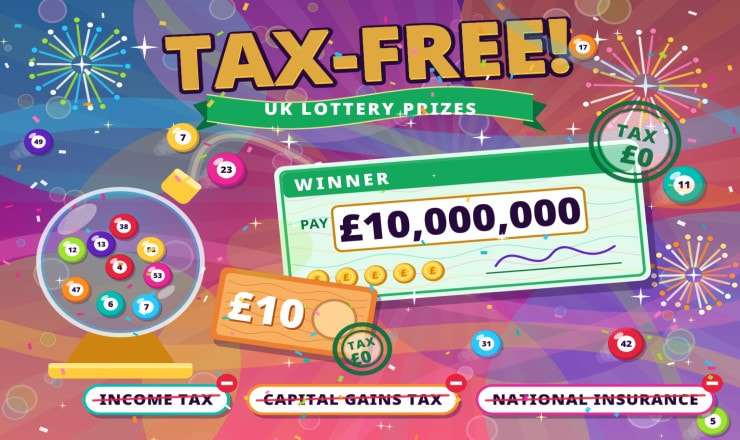
No, your lottery win is tax-free, whether you win £10 or £10 million. The legal footing sits in the Taxation of Chargeable Gains Act 1992. Section 51 says that ‘winnings from betting, including pool betting, or lotteries or games with prizes are not chargeable gains’, so Capital Gains Tax never applies to your prize.
A lottery win is not generally treated as taxable income, so Income Tax does not apply to the prize itself. The UK Gambling Commission stated this clearly in a 2026 Freedom of Information response.
‘In the UK, winnings from gambling for customers are tax-free, regardless of the amount won.’
Instead of taxing winners, the UK taxes the operator. Section 24 of the Finance Act 1993 sets up Lottery Duty as an excise duty, charged whenever a ticket or chance in a lottery is taken in the UK. The National Lottery licence holder pays Lottery Duty at 12% of the stake money taken in each accounting period, so the tax is settled at the ticket-sales end. The draw-by-draw table shows how this applies to each game.
Casino, betting and poker winnings generally follow the same principle, and the full guide on whether gambling winnings are taxable in the UK gives the most important details. If you also play online, you should learn when to withdraw your winnings, as the practical side of moving money out of a casino account is an issue to consider separately.
Yet, this guide explains the general rules and is not financial or tax advice. For your own situation, check the current guidance on GOV.UK and speak to a qualified tax adviser before you move a large sum.
Tax on Lottery Winnings by Draw
For the lottery products listed below, the prize is not taxed in the winner’s hands. National Lottery games carry Lottery Duty, while society lotteries are exempt from it. EuroMillions winnings sit in the first group. Find more in the table below.
| Draw | Taxed for You? | Why |
|---|---|---|
| Lotto | No | National Lottery game, so the licence holder pays Lottery Duty on ticket sales. |
| EuroMillions | No | Sold as a National Lottery game in the UK, with Lottery Duty paid by the licence holder. |
| Thunderball | No | National Lottery game, covered by the same duty. |
| Set For Life | No | National Lottery game, covered by the same duty. |
| Scratchcards and Instant Win Games | No | National Lottery products, covered by the same duty. |
| Health Lottery | No | Society lottery, exempt from Lottery Duty, and the prize is not income or a chargeable gain. |
| People’s Postcode Lottery | No | Society lottery, exempt from Lottery Duty, and the prize is not income or a chargeable gain. |
| Syndicate or shared ticket | No | Each share is a lottery win, and a prior agreement keeps Inheritance Tax out of the share-out. |
Society lotteries are often misunderstood in this context. GOV.UK guidance states that all lawful lotteries are exempt from the duty except the National Lottery. That exemption concerns the operator only. It creates no tax on the winner’s side, because section 51 covers lotteries generally and a prize is not income.
The UKGC has regulated the National Lottery since the National Lottery Commission merged into it on 1 October 2013. Allwyn now runs the draws under the Fourth National Lottery Licence, in effect from 1 February 2024. The guide to how the UK Gambling Commission works explains its wider role, while the detailed page about the history of online gambling in the UK fills in the background.
Premium Bonds and Game Show Prizes
You do not pay tax on Premium Bond winnings either. The prize fund rate is variable, so check NS&I for the current figure before you compare it with a savings account. Game show winnings work in a similar way. A prize from a TV quiz or a magazine competition is not usually taxable for the winner.
An exception may apply when entering competitions is carried out as someone’s trade or profession, in which case prizes may be treated as business income. It is a narrow case, and an adviser is the right person to judge it.
What Is Taxed After You Win
The prize reaches you tax-free, but what the money earns afterwards is taxed in the usual way. The table below shows the allowances and rates for 2026/27. To keep more of it, see the ISA and gifting options below.
| Type | Tax-free allowance | Rate 2026/27 |
|---|---|---|
| Savings interest | £1,000 basic rate, £500 higher rate, £0 additional rate, plus the £5,000 starting rate for savings | 20% / 40% / 45%, rising to 22% / 42% / 47% from April 2027 |
| Dividends | £500 | 10.75% / 35.75% / 39.35% (Autumn Budget 2025, from April 2026) |
| Rental income | £1,000 property allowance | 20% / 40% / 45%, rising to 22% / 42% / 47% from April 2027 |
| Capital gains (shares, property) | £3,000 annual exempt amount | 18% / 24% |
| Inheritance Tax | £325,000 nil-rate band, plus the £175,000 residence nil-rate band | 40% above the threshold |
Lottery Syndicates and Inheritance Tax
Syndicates raise one specific risk. When a single member holds the ticket and shares the prize out with no agreement in place, the distribution may be treated as gifts from that person, which pulls the seven-year rule into play.
HMRC Statement of Practice E14 deals with exactly this. It confirms that no Inheritance Tax arises on syndicate winnings paid out in accordance with the terms of an agreement drawn up before the win. In that case, each member receives what already belongs to them.
The same statement suggests members may think it wise to record the arrangement in a written, signed and dated statement. The National Lottery offers a sample syndicate agreement, which gives your group a starting point before the first ticket is bought.
How to Avoid Tax on Lottery Winnings
The prize itself is generally tax-free, so tax planning concerns income, gains or estate value arising after the win. An ISA (Individual Savings Account) is the obvious first step, since it is a tax-free savings wrapper with a £20,000 allowance for 2026/27. From April 2027, the Cash ISA limit falls to £12,000 for savers under 65. Beyond that, the savings and dividend allowances above set how much the money can earn before tax starts.
Gifting is another estate-planning consideration. Using the annual and small-gift exemptions each year shrinks the estate that Inheritance Tax is measured against. Wedding or civil partnership gifts have separate limits of £5,000 to a child, £2,500 to a grandchild or great-grandchild and £1,000 to anyone else. Regular gifts from monthly income have no limit, as long as you can still cover your usual living costs.
If the giver dies within seven years, taper relief lowers the tax rate on the gift, from 32% at three to four years to 8% at six to seven years, and to nothing after that. The relief only applies if gifts made in the seven years before death total more than the £325,000 tax-free threshold. After a large win, a tax adviser can check which of these rules apply to you.
Winning Abroad or Living Overseas
A ticket bought in another country is subject to that country’s rules, which may treat the prize differently. In the United States, lottery tickets are usually bought in person in the state running the draw, and US lotteries generally withhold 30% from the winnings of non-residents.
UK residents can usually avoid that deduction, as IRS Publication 515 lists the United Kingdom among the treaty countries whose residents’ gambling income is not taxable by the United States. To claim the exemption, a UK resident gives the payer a Form W-8BEN with a tax identification number. If the tax has already been withheld, reclaiming it afterwards means filing with the IRS.
If you live outside the UK, check the rules of the country where you are resident, because any tax on a win would be decided there rather than here.
Frequently Asked Questions
The questions below address common concerns about lottery prizes and tax. So, without further ado, here are the short answers to the most searched questions by players like you.
Sources & Further Reading
- Winnings From Gambling for Customers (12 May 2026) – UK Gambling Commission
- Taxation of Chargeable Gains Act 1992, Section 51 – legislation.gov.uk
- Finance Act 1993, Section 24 – legislation.gov.uk
- Lottery Duty – GOV.UK
- Excise Notice 458: Lottery Duty – HM Revenue & Customs
- Premium Bonds – NS&I
- Tax on Savings Interest – GOV.UK
- Tax on Dividends – GOV.UK
- Income Tax: Changes to Tax Rates for Property, Savings and Dividend Income (27 November 2025) – HM Revenue & Customs
- Income Tax Rates and Personal Allowances – GOV.UK
- Tax-Free Allowances on Property and Trading Income – GOV.UK
- Capital Gains Tax: Allowances – GOV.UK
- Capital Gains Tax: Rates – GOV.UK
- Inheritance Tax – GOV.UK
- Inheritance Tax: Gifts – GOV.UK
- Publication 515: Withholding of Tax on Nonresident Aliens and Foreign Entities – Internal Revenue Service
- Statement of Practice E14 – HM Revenue & Customs
- Syndicates – The National Lottery – The National Lottery
- Are Gambling Winnings Taxable in the UK? – BestCasino.co.uk
- UK Gambling Commission Guide – BestCasino.co.uk
- History of Online Gambling in the UK – BestCasino.co.uk
- When to Withdraw Your Winnings – BestCasino.co.uk