Cascading Reels Explained: Tumbling Slots
Cascading reels are a game mechanic in modern video slots that drops symbols into the grid rather than spinning them into place. Winning symbols clear, new ones fall into the gaps, and the chain keeps going until a drop pays nothing. Below you will find how one chain resolves, which games use this mechanic, the UK rules that decide how a cascade round plays out, and more.
 Written by:
What Cascading Reels Actually Are
The short version is this: after a win, symbols fall into the grid rather than a new paid spin beginning. This is the basic explanation of the cascading reels mechanic, which is also known by several different names.
Relax Gaming, which builds tumbling reels slots of its own, calls them avalanche games, tumble games or cascading reels. The company defines them as ‘a type of slot game in which symbols fall or cascade into place on the reels rather than spinning in place’. However, the part that matters comes after a winning combination.
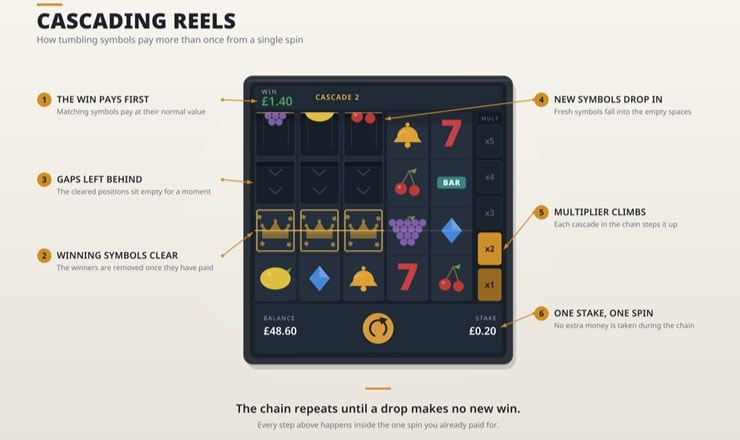
In the studio’s own words, ‘when a winning combination is formed, the winning symbols will disappear and be replaced by new symbols, which can potentially create additional winning combinations. This process continues until no more winning combinations are formed.’ Overall, a single round can be divided into four stages:
- The Spin Lands a WinMatching symbols pay at their normal value for the stake you set.
- The Winning Symbols ClearThey are removed from the grid and leave gaps behind them.
- New Symbols Drop InFresh symbols fall into the gaps and the grid fills back up.
- The Chain Continues or StopsAnother win restarts the sequence. No win, and the round is finished.
These four stages happen very fast and, most importantly, none of that is a bonus. A cascade chain is one paid spin still resolving, and the game cannot take a second stake off you part-way through it.
Note that cascades and Megaways can easily be confused as one thing, which they are not. Cascading reels are a mechanic, describing how symbols arrive on the grid, while Megaways is a ways-to-win modifier that changes how many symbols each reel holds. Megaways is a feature used across different types of slots games, while cascading symbols are a core game mechanic.
Where the Multiplier Comes In
The multiplier is what makes a long chain behave differently from four separate small wins, and two designs cover most of the market. The first is a climbing ladder, where the multiplier steps up with every consecutive cascade. For instance, Gonzo’s Quest has an Avalanche multiplier that climbs to a maximum of 5x in the base game and 15x during the Free Falls bonus round.
Bonanza takes the ladder further. Four GOLD scatters award 12 free spins, and each cascade during those spins raises the multiplier by 1x with no upper limit. It does not reset between spins either, so the multiplier built on spin two remains active on spin nine.
Sweet Bonanza from Pragmatic Play drops multiplier symbols during the chain, and the studio describes it directly: ‘multiplier symbols with values between 2x-100x can hit, and at the end of the tumbling sequence, the values of all multiplier symbols add together’. Wins there come from 8-12+ matching symbols landing anywhere on the tumbling reels rather than on paylines.
Each design pays you for something different. A ladder rewards an unbroken run, so the tenth cascade is worth far more than the first. A collect-and-add game is indifferent to how long the chain lasts and only cares whether multiplier symbols happened to land inside it.
Same Mechanic, Different Names
As noted above, different game studios use different names for their avalanche reels slots. Trademarks explain most of the list below. Rolling Reels removes winning symbols, drops new symbols into the resulting gaps, and lifts the multiplier with each successive win. In short, this is the avalanche pattern wearing a different badge.
| Mechanic Name | Studio | Example Game |
|---|---|---|
| Avalanche™ | NetEnt | Gonzo’s Quest |
| Rolling Reels™ | Games Global | Chronicles of Olympus |
| Reactive Reels™ | Big Time Gaming | Bonanza |
| Tumble | Pragmatic Play, Relax Gaming | Sweet Bonanza, Temple Tumble |
| Cascading reels | Generic Industry Label | Most Megaways Titles |
Relax Gaming keeps to the plain word tumble across Temple Tumble and Sloth Tumble. Overall, ‘cascading reels’ is the generic label, and although Megaways does not require cascading reels, it is the one you will meet on most Megaways titles. Where the designs genuinely differ is in the multiplier rules, not in the dropping. Megaclusters, another Big Time Gaming mechanic, builds on the same cascade idea with symbols that split into smaller ones. Our comparison of Megaways, Megapots and Megaclusters explains how it differs from BTG’s other branded engines.
Games That Use It
Here are several popular tumbling reels slots. Use them as starting points or as examples of top video slots at online casinos, although the mechanic behaves slightly differently in each game.
- Gonzo’s Quest is where the mechanic got famous, with a base-game ladder that stops at 5x.
- Bonanza runs the uncapped version, adding 1x per cascade right through the free spins.
- Temple Tumble is Relax Gaming putting its own tumble build on a Megaways layout.
- Megaways slots cascade by default in almost every case, and the ranked list shows the top titles.
- The online slots hub groups all other kinds of video slots by feature for side-by-side comparison.
One useful exception is Centurion Megaways. It carries no cascading reels at all, which our Megaways page flags as an uncommon omission for the format. A Megaways badge on a lobby tile is not a promise that symbols will drop.
You should also read the game specifications and review all the details of their mechanics. These are usually explained in the slot’s paytable or information section. Don’t forget to check the stated RTP and volatility level as well, as these can affect how the game feels during play.
What Cascades Do to Variance
The rule is simple: your stake was taken when you pressed the spin button, and every cascade after that belongs to the same round. No extra spin is awarded either.
Then there is the maths. A slot with cascading reels was modelled with them in place, so the published RTP already includes every cascade the game will ever pay. It does not become more generous because its symbols drop rather than spin.
A free spin is a separate round the game gives you. A cascade is part of the paid round that is still resolving. Where a lobby tile or a feature list presents tumbles as extra spins, that is a description of the animation rather than of the value.
What the mechanic really changes is where the return sits. Many cascading-reel games are high variance, particularly where long chains and multipliers drive a large share of the potential return. The full blog post about high variance and low variance slots takes that explanation further.
How UK Rules Change a Cascade Round
At a British online casino, a cascade round may play differently from versions offered in markets that permit faster game-play features. Three requirements in the UK Gambling Commission remote technical standards do that work, all of which affect game speed and presentation.
Speed is fixed at the level of the round. RTS 14D states that ‘it must be a minimum of 2.5 seconds from the time a game is started until the next game cycle can be commenced’. A game cycle begins ‘when a player depresses the start button or takes equivalent action to initiate the game’ and ends ‘when all money or money’s worth staked or won during the game has been either lost or delivered to, or made available for collection by the player’.
Players also cannot speed up the result. RTS 14E is a single line: ‘The gambling system must not permit a customer to reduce the time until the result is presented.’ UKGC guidance names what that removes, confirming that ‘features such as turbo, quick spin and slam stop are not permitted’. At a UK-licensed casino you cannot skip a cascade chain, and it plays out at its own pace.
RTS 14F is another one worth spelling out. It requires that ‘the gambling system must not celebrate a return which is less than or equal to the total stake gambled’, with celebrate defined as ‘the use of auditory or visual effects that are associated with a win’. This requirement can be particularly relevant to cascading games.
Three or four cascades in a row can appear to be a significant result, yet the round can still return less than you staked, and UK rules stop the game from playing win effects over it. Overall, the number in your balance is the honest read, not the animation.
Autoplay is separately prohibited on slots under RTS 8, so nobody can set a hundred cascade rounds running and walk away. Every round is one a player committed to individually.
Frequently Asked Questions
The questions below are among those we are asked most often about tumbling reels, the multiplier layer and what UKGC rules allow. Read them if you wonder about the benefits of cascading reels vs Megaways slots, or what this mechanic does to the variance of a video slot.
Sources and Further Reading
- RTS 14: Responsible Product Design, UK Gambling Commission (last updated 12 January 2026).
- Slot Games: Back To Basics, Relax Gaming (January 2023).
- Gonzo: The Quest So Far, NetEnt.
- Sweet Bonanza game page, Pragmatic Play.
- Types of slots games, the format taxonomy on BestCasino.co.uk.
- High variance vs low variance slots, our volatility explainer.