Why the Same Slot Pays a Different RTP at Different Casinos
Some video slots, such as Book of Dead, can have a set 96.21% payout rate at one casino and 84.18% at another, and the reels look identical. The game still feels the same, but its software developer, Play’n GO, has made it available in several RTP variants, and each casino site picks one. We explain why, how to check the version you are actually playing, and what a lower RTP rate costs over a session, among other interesting topics.
 Written by:
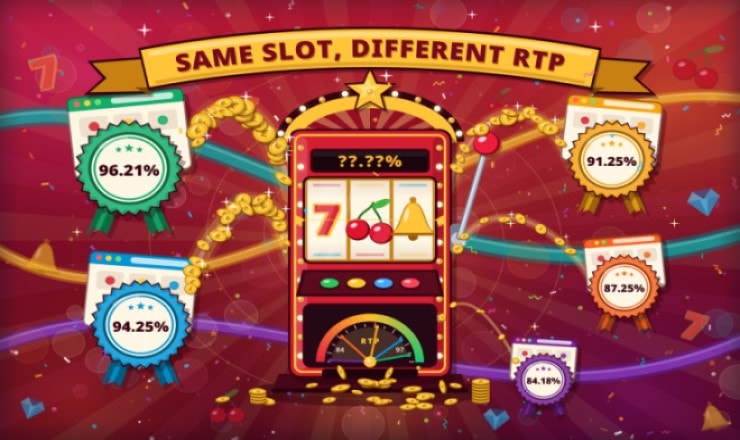
One Slot, Several RTP Builds
Let’s begin with Book of Dead again, as it exists not in two or three, but in five different payout versions. Play’n GO lists builds of 96.21%, 94.25%, 91.25%, 87.25% and 84.18% RTP for Rich Wilde and the Book of Dead, with 96.21% as the default configuration. The reels, the symbols and the 5,000x win cap are the same in every one, so nothing on screen shows which build a casino has loaded.
This figure, also known as RTP percentage, represents the share of all money staked that a slot is designed to pay back over its lifetime, averaged across every player. If you are unfamiliar with this game statistic, we recommend reading the full guide to what RTP means, as it covers all the basics. This post starts where the RTP guide stops, at the point where one game can carry several sets of RTP maths.
This post also has nothing to do with the difference between pub machines and online games, which we explain in pub vs online slots RTP. Here the game and the provider stay the same. Only the build the casino site chooses changes. Because there are many examples, the table below shows games from five providers only.
| Slot | Provider | RTP Figures on the Public Page |
|---|---|---|
| Rich Wilde and the Book of Dead | Play’n GO | 96.21%, 94.25%, 91.25%, 87.25%, 84.18% (default 96.21%) |
| Chaos Crew 2 | Hacksaw Gaming | 96.27%, 94.22%, 92.41%, 88.28% |
| Money Train 3 | Relax Gaming | German RTP 90.00%, alternative RTP 94.00%, plus an alternative UK game ID (Moneytrain3_92) |
| Gates of Olympus | Pragmatic Play | One headline figure: 96.50% |
| Sweet Bonanza | Pragmatic Play | One headline figure: 96.48% |
| Mental | Nolimit City | One headline figure: 96.08% |
Pragmatic Play and Nolimit City show one headline number on the public pages we checked. That is the figure the provider leads with. It does not prove the game exists in only one version, so treat a single published RTP as a starting point. Relax Gaming is a useful contrast. Its Money Train 3 page lists a German figure, an alternative figure and a separate UK game ID, which shows how far one title can be split by market and by build.
Why a Casino Picks a Lower Setting
Commercial agreement and regulatory obligationsare always the simplest reason for a selection like this. For instance, at the 96.21% build of Book of Dead the house edge is 3.79%, and at 94.25% it is 5.75%. On the same amount of play, the casino keeps roughly half as much again.
Promotions are a second important reason, as free spins, deposit matches and cashback all cost the casino money. Supplier and platform costs may also affect an operator’s commercial decisions, although this cannot be assumed for any individual game.
Casino sites often take their games through a platform or aggregator, and any fees on that content come out of what the games earn. A lower RTP build would leave more room to cover them.
In every case, the choice is a business decision. The UK rules we look at below focus on the information you get before you play, which is why the in-game figure matters more than the name of the game.
How to Check the RTP You Are Playing
The relevant figure is the RTP displayed in the game information panel at the casino where you play. Check it for each game and casino, particularly after a game or platform update. The same title can differ from one casino to the next. Here are the most important steps, tips, and practical bits of advice.
- Open the Info Panel Before Your First Spin. Look in the paytable, rules or help screen for a stated RTP. It can sit at the end of the rules text, so scroll the whole screen.
- Note the Exact Figure, Decimals Included. Several builds can differ by only a few percentage points, and the decimals are what identify the version.
- Match It Against the Provider’s Full List. If a game is designed with a 96.21% RTP by default and, for example, you see a reading of 87.25% or 84.18% RTP at a certain casino, it means the operator chose a lower one.
- Treat Outside Figures as a Ceiling. A number quoted on a review site or provider page can be the default or top build, which may not be what your casino runs. That applies to lists like the one included in the guide to slot RTP rates.
- Compare Across the Casinos You Use. If one site shows the top build and another a reduced one, your stake and the game are the same, yet the long-run cost is different.
- Ask in Writing If No Figure Appears. Contact support, name the exact game and ask which RTP version the casino runs. A written reply gives you something to refer back to.
What the UKGC Requires Casinos to Show
The UK Gambling Commission sets game-information rules in its Remote gambling and software technical standards. The relevant section is RTS 3, ‘Rules, game descriptions and the likelihood of winning’, last updated on 7 May 2024.
‘For each virtual event, game (including bingo), or lottery, information that may reasonably be expected to enable the customer to make an informed decision about his or her chances of winning must be easily available before the customer commits to gamble.’
The UKGC implementation guidance then lists what counts as acceptable information. It includes the average theoretical return to player percentage, with house edge or the probability of winning events as the alternatives. So a game may show a house edge instead, and subtracting it from 100 gives you the RTP.
RTS 3A adds a second duty. It says ‘the content including artwork and text must be accurate, and sufficient to explain all of the applicable rules and how to participate.’
Licensed casino operators must also meet the UKGC’s Licence Conditions and Codes of Practice (LCCP) condition 2.2.1: ‘Licensees must comply with the relevant remote gambling and software technical standards.’ Independent test laboratories such as eCOGRA, GLI, iTech Labs, and BMM Testlabs assess slot-game versions before release.
This matters because the same slot may be supplied with different RTP settings at different casino sites. It comes down to checks like random number generator, game mathematics, and the stated RTP configuration, so the percentage shown in a game’s information panel has independent verification for that specific build.
What a Two-Point Gap Costs
Theoretical expected loss can be calculated by multiplying the total staked by the house edge (100% minus the RTP). Take a hypothetical session of 500 spins at £1, so £500 staked in total.
At the 96.21% build of Book of Dead, the expected cost of that session is £18.95. At 94.25% it rises to £28.75, which is £9.80 more for the same play. The gap is 1.96 points, yet the house edge grows by about half. Here are more examples:
| RTP Build | House Edge | Expected Cost on £500 Staked |
|---|---|---|
| 96.21% | 3.79% | £18.95 |
| 94.25% | 5.75% | £28.75 |
| 91.25% | 8.75% | £43.75 |
| 87.25% | 12.75% | £63.75 |
| 84.18% | 15.82% | £79.10 |
At the lowest RTP configuration, the expected cost is more than four times the default, while nothing else about the session has changed. Any single session can finish far above or far below them, because RTP describes the average across all players and all spins over the life of the game. For the wider picture on choosing games, see the detailed online slots strategy guide.
Volatility and the RTP Setting
Play’n GO publishes a single volatility rating for Book of Dead (high) rather than one per RTP build. Hacksaw Gaming does the same for Chaos Crew 2, rating it 5 out of 5 across all four versions. A single volatility label does not establish that every RTP configuration has identical hit frequency or payout distribution.
The safest reading is that the volatility label describes the character of the game, while the RTP variant changes the game’s theoretical long-run return. You can find both high and low variance slots with different RTP rates, and this combination can influence how a game feels over a longer session.
Overview and Final Thoughts
Video slots may be made available in different RTP variants, and the casino operators decide which one you get. The figure in the game’s own info panel is the one that applies to you, and UKGC standards require information on your chances to be easily available before you play.
Frequently Asked Questions
This is the final section of this blog post, featuring quick answers on RTP versions, how to check them and what the UK rules say. If you plan to play the same video slot at different online casinos, review these questions first.
Sources & Further Reading
- RTS 3: Rules, Game Descriptions and the Likelihood of Winning (updated 7 May 2024) – UK Gambling Commission
- Rich Wilde and the Book of Dead – Play’n GO
- Chaos Crew 2 – Hacksaw Gaming
- Money Train 3 – Relax Gaming
- Gates of Olympus – Pragmatic Play
- What Is RTP? A UK Beginner’s Guide – BestCasino.co.uk
- Slot RTP Table – BestCasino.co.uk
- Pub vs Online Slots RTP – BestCasino.co.uk
- High vs Low Variance Slots Explained – BestCasino.co.uk